Education Loan Interest Rates 2026: SBI vs HDFC vs ICICI vs Axis Compared
When Rahul started shopping for an education loan for his son’s engineering degree, he assumed the education loan interest rate would be more or less the same everywhere — maybe a difference of half a percent at most. He was wrong. Between the four quotes he collected, the gap was wide enough to change his total repayment by over ₹1.5 lakh across the loan tenure. That’s the kind of difference most people never bother checking, because banks don’t exactly advertise it clearly.
Here’s a straight comparison of where things stand right now, and more importantly, what actually moves your rate up or down.
Current Interest Rates by Bank
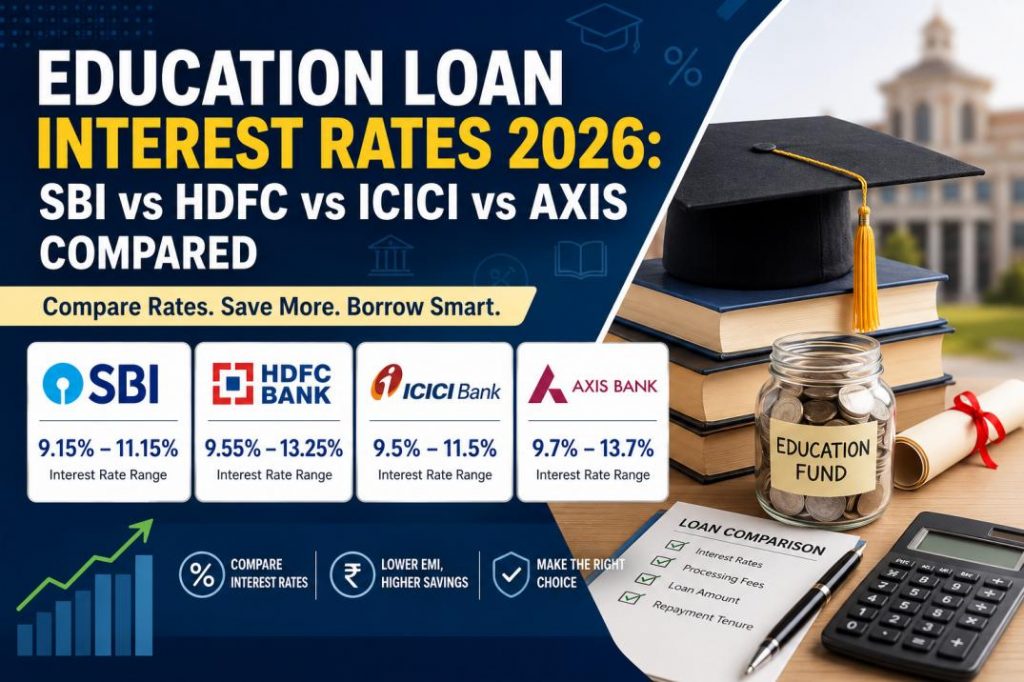
| Bank | Interest Rate Range | Processing Fee | Max Loan (Without Collateral) |
|---|---|---|---|
| SBI | 9.15% – 11.15% | Nil for most education loans | ₹7.5 lakh |
| HDFC Bank | 9.55% – 13.25% | Up to 1.5% of loan amount | ₹7.5 lakh (via Credila) |
| ICICI Bank | 9.5% – 11.5% | Up to 1% of loan amount | ₹4 lakh (higher with collateral) |
| Axis Bank | 9.7% – 13.7% | Up to 1.5% of loan amount | ₹4 lakh (higher with collateral) |
Note: These rates fluctuate with RBI’s repo rate changes and internal bank policy. Always confirm the current rate directly with the bank before applying — treat this table as a starting point for comparison, not a locked-in quote.
Why Rahul’s Rates Varied So Much
A few things decide where you actually land within a bank’s range, not just which bank you pick:
1. Which institution you’re studying at
Public sector banks like SBI maintain a list of “premier institutions” (IITs, IIMs, NITs, and similar). If your admission is to one of these, you often get the lower end of the rate range automatically, sometimes with reduced or waived collateral requirements too.
2. Collateral vs. no collateral
Loans above ₹7.5 lakh usually require collateral (property, fixed deposit, or a third-party guarantee). Secured loans consistently get better rates than unsecured ones — often a full percentage point lower — because the bank’s risk is lower.
3. Your co-applicant’s credit profile
Since students rarely have credit history, the loan is assessed largely on the co-applicant’s (usually a parent’s) credit score and income stability. A CIBIL score above 750 for the co-applicant can meaningfully improve the offered rate.
4. Fixed vs. floating rate
Most education loans in India are floating rate, tied to the bank’s repo-linked lending rate (RLLR). This means your EMI can change if RBI changes the repo rate during your loan tenure — worth knowing before you lock in, since a “great rate today” can shift a year later.
A Practical Example
Suppose you’re borrowing ₹10 lakh for a 7-year tenure. Here’s how just a 1.5% rate difference plays out:
| Interest Rate | Monthly EMI | Total Interest Paid |
|---|---|---|
| 9.5% | ₹16,270 | ₹3,66,680 |
| 11% | ₹17,315 | ₹4,54,460 |
That 1.5% difference works out to nearly ₹88,000 more in interest over the loan term — money that’s easily avoidable just by comparing offers before signing.
How to Actually Negotiate a Better Rate
- Get quotes from at least 3 banks before choosing — most people apply to whichever bank they already have an account with, without checking if a competitor offers better terms.
- Ask about the “special scheme” rates — many banks have discounted rates for specific fields (medicine, engineering, management) or specific universities, which aren’t always mentioned upfront unless you ask directly.
- Check if your existing bank offers a relationship discount — if your family already banks with a particular institution, some offer a marginal rate reduction for existing customers.
- Consider a top-up on an existing loan rather than a fresh application, if you or a family member already has a running loan with good repayment history — this sometimes qualifies for preferential pricing.
Frequently Asked Questions
Do government banks always offer lower rates than private banks?
Generally yes, especially for loans without collateral, since public sector banks like SBI have education-loan-specific schemes with government backing. But private banks sometimes beat them for premier institutions or larger loan amounts with strong collateral.
Can I switch banks partway through my loan for a better rate?
Yes, this is called a balance transfer. If another bank offers a meaningfully lower rate, transferring the outstanding loan can save money, though you’ll need to account for processing fees and paperwork on the new loan.
Does the interest rate change if I study abroad instead of in India?
Often yes — loans for studying abroad frequently carry a slightly higher rate than domestic courses, and collateral requirements tend to be stricter given the larger loan amounts usually involved.
Is there a difference in rate between government and private universities in India?
Yes, in most cases. Government-recognized premier institutes typically unlock the lowest rate tier, while lesser-known private colleges may fall into a higher risk bracket with correspondingly higher rates.
Want to see exactly how a specific interest rate and tenure will affect your monthly EMI and total repayment? Try our Education Loan EMI Calculator and compare a few scenarios before you finalize which bank to go with.
For official, up-to-date repo rate information that affects floating loan rates, refer to the Reserve Bank of India’s press releases page.
Try our free calculators
Put this into practice with CalculatorWala's accurate, India-focused financial tools.
Open Calculators