How Much Down Payment Should You Pay on a Bike Loan?
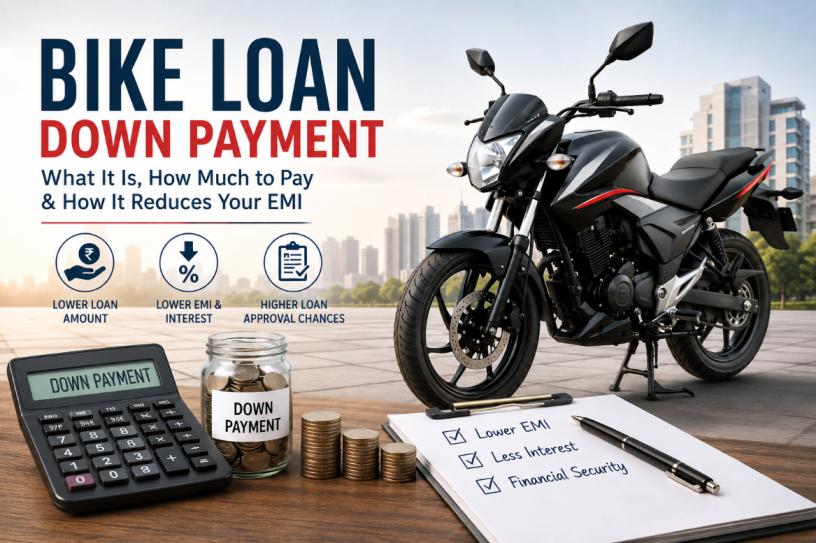
When you take a two-wheeler loan, one of the first decisions you’ll face is: how much down payment should I pay? Pay too little and your EMIs balloon. Pay too much and you drain your savings unnecessarily. This guide helps you find the right balance.
What is a Down Payment on a Bike Loan?
A down payment is the portion of the vehicle’s price you pay upfront from your own pocket. The lender finances the rest. For example, if a bike’s on-road price is ₹1,20,000 and you pay ₹30,000 yourself, your loan amount is ₹90,000.
The down payment directly affects three things: your loan amount, your monthly EMI, and the total interest you’ll pay over the loan’s life.
How Much Down Payment is Typical?
In India, most lenders ask for a down payment of 10% to 20% of the on-road price. Some dealer-tied financiers advertise low or zero down payment schemes to attract buyers, but these come with trade-offs.
- Minimum down payment — usually 5% to 10%, often just covering RTO and insurance
- Recommended down payment — 20% to 30% for a comfortable EMI
- Zero down payment — available from some lenders, but expensive in the long run
The Real Impact of Down Payment: A Comparison
Let’s compare three scenarios for a bike with a ₹1,20,000 on-road price, at 11% interest over 3 years:
| Down Payment | Loan Amount | Monthly EMI | Total Interest |
|---|---|---|---|
| ₹0 (Zero) | ₹1,20,000 | ≈ ₹3,928 | ≈ ₹21,406 |
| ₹20,000 | ₹1,00,000 | ≈ ₹3,273 | ≈ ₹17,838 |
| ₹40,000 | ₹80,000 | ≈ ₹2,618 | ≈ ₹14,270 |
Notice that paying ₹40,000 upfront instead of nothing saves you over ₹7,100 in interest and cuts your EMI by ₹1,310 a month. That’s the power of a higher down payment.
Pros and Cons of a Higher Down Payment
Advantages
- Lower EMI — easier on your monthly budget
- Less total interest — you save real money over the tenure
- Faster equity — you owe less from day one
- Easier approval — lenders see lower risk
Disadvantages
- Drains savings — less cash on hand for emergencies
- Opportunity cost — that money could earn returns elsewhere (though bike loan rates are usually higher than safe investment returns, so this rarely wins)
Should You Choose a Zero Down Payment Loan?
Zero down payment schemes are tempting because they let you ride away without spending upfront. But they almost always mean a larger loan, higher EMIs, and significantly more interest. They make sense only if you genuinely have no spare cash and need the vehicle urgently for income (like a delivery job).
For most buyers, paying at least 20% down is the smarter long-term choice.
Find Your Ideal Down Payment
The best way to decide is to test different numbers. Use our free Bike Loan EMI Calculator — adjust the down payment slider and instantly see how your EMI and total interest change. It takes 30 seconds and could save you thousands.
Frequently Asked Questions
What is the minimum down payment for a bike loan in India?
Most lenders require a minimum of 5% to 10% of the on-road price, though some offer zero down payment schemes on the ex-showroom price.
Does a higher down payment reduce interest rate?
Not directly, but a higher down payment reduces your loan amount, which lowers the total interest you pay over the tenure. It can also improve your approval odds.
Is it better to pay a big down payment or invest that money?
Since bike loan interest rates (9.5%-13%) are usually higher than returns from safe investments, paying a larger down payment typically saves you more than investing the same amount would earn.
Try our free calculators
Put this into practice with CalculatorWala's accurate, India-focused financial tools.
Open Calculators