Education Loan Moratorium Period Explained: How Interest Really Works
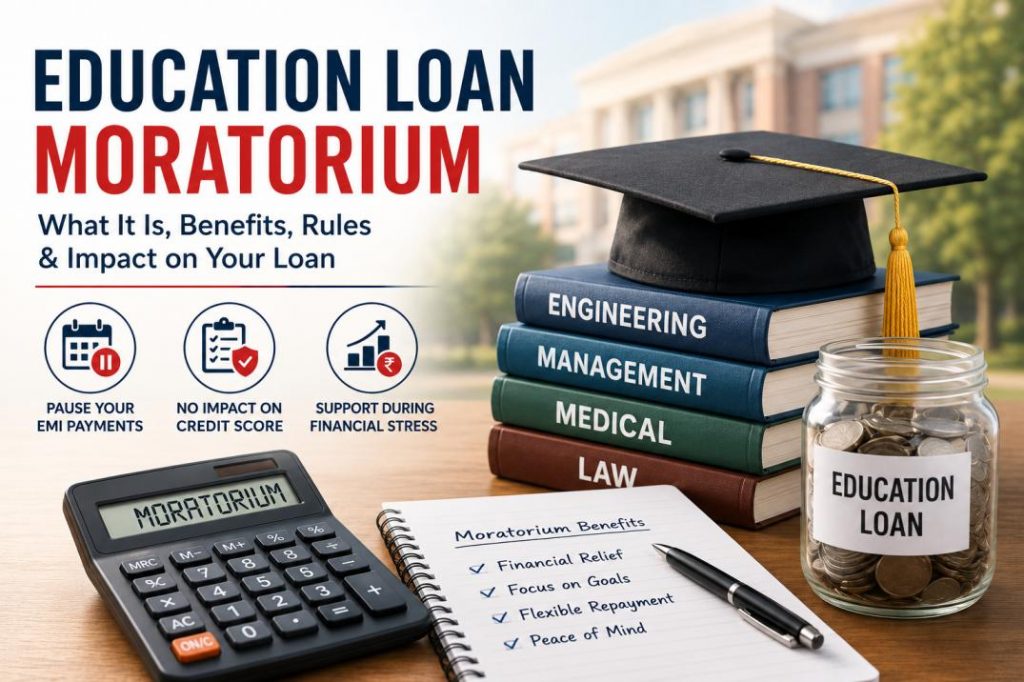
One feature makes education loans uniquely student-friendly: you don’t have to start repaying while you’re still studying. This breathing room is called the moratorium period. But it’s widely misunderstood — and that misunderstanding can cost you money. Here’s exactly how it works.
What is a Moratorium Period?
The moratorium period (also called the repayment holiday) is the time during which you are not required to pay your regular EMIs. It covers your study years plus a short grace period after you finish, giving you time to find a job before repayment begins.
A typical moratorium = course duration + 6 months to 1 year grace period.
So for a 2-year master’s program with a 1-year grace period, your moratorium would be 3 years. Your EMIs begin only after that.
The Catch: Interest Still Accrues
Here’s what many students miss — interest builds up during the moratorium, even though you’re not paying EMIs. This is simple interest charged on the disbursed loan amount.
If you don’t pay this interest during the moratorium, it gets added to your principal when repayment starts. This is called capitalisation, and it means you end up paying interest on interest later.
Example: The Real Cost of Waiting
Let’s say you take a ₹10 lakh education loan at 10% interest, with a 3-year moratorium (2-year course + 1-year grace).
| Scenario | What Happens |
|---|---|
| You pay interest during moratorium | You pay roughly ₹8,300/month in simple interest during the 3 years. Your principal stays at ₹10 lakh when EMIs begin. |
| You don’t pay during moratorium | About ₹3 lakh of interest accumulates and gets added to your loan. EMIs are then calculated on ₹13 lakh — meaning higher EMIs and more total interest. |
The difference can run into lakhs over the full loan. Paying even the simple interest during your moratorium — if you can manage it — saves a substantial amount.
Should You Pay During the Moratorium?
If you can afford it, yes. Paying the simple interest during your study years prevents capitalisation and keeps your future EMIs lower. Many banks even offer a small interest concession (often 0.5% to 1%) if you service interest during the moratorium.
If you genuinely can’t pay — which is common for full-time students — that’s fine; the moratorium exists precisely for this. Just go in knowing your loan will be larger when repayment begins.
Section 80E: Tax Benefit on Interest
Once you start repaying, there’s good news. Under Section 80E of the Income Tax Act, the entire interest paid on an education loan is 100% tax-deductible — with no upper limit — for up to 8 years from when repayment begins. The principal portion is not deductible, but the interest benefit is significant.
Calculate Your Moratorium Interest
Want to see exactly how much interest will build up during your moratorium, and how it affects your EMI? Our free Education Loan Calculator lets you toggle “pay interest during moratorium” on and off — so you can see both scenarios side by side and make an informed choice.
Frequently Asked Questions
What is the moratorium period in an education loan?
It’s a repayment holiday covering your course duration plus 6 months to 1 year, during which you don’t pay regular EMIs. Simple interest still accrues during this time.
Do I have to pay anything during the moratorium?
Regular EMIs are not required, but interest accrues. You can choose to pay just the simple interest to avoid it being added to your principal later — and may get an interest concession for doing so.
What happens if I don’t pay interest during the moratorium?
The accrued interest is added to your principal (capitalised) when repayment begins, increasing your EMI and total interest paid.
Is education loan interest tax-deductible?
Yes. Under Section 80E, the full interest amount is deductible from taxable income for up to 8 years after repayment starts, with no upper limit.
Try our free calculators
Put this into practice with CalculatorWala's accurate, India-focused financial tools.
Open Calculators